
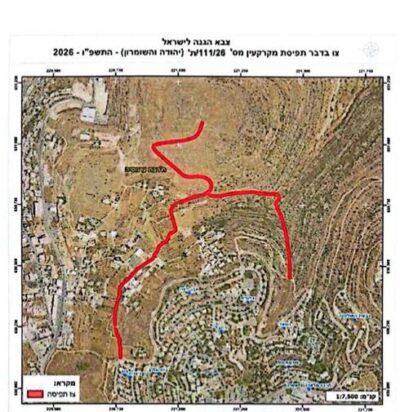
Israeli occupation authorities have issued a new military land‑seizure order confiscating 16.577 dunams of privately owned Palestinian land in the village of Doura al‑Qare’, northeast of Ramallah in the central part of the occupied West Bank.
The Wall & Colonization Resistance Commission stated that the order targets a strip of land approximately 2,076 meters long that surrounds the illegal colony of Beit El from three sides, effectively expanding the colony’s security perimeter and restricting Palestinian access to surrounding agricultural areas.
The Commission said the order—described by the occupation authorities as “temporary”—is part of a broader pattern of military land seizures issued throughout 2026.
In its mid‑year report, the Commission documented 40 military land‑seizure orders covering 611 dunams of Palestinian land.
These orders resulted in the creation of four new buffer zones around colonies, the construction of 16 “security roads”, and the establishment of 12 military sites, in addition to other military uses.
The illegal colony of Beit El, established in 1977, is one of the most politically influential colonies in the occupied West Bank.
It hosts Israeli military and intelligence headquarters for the region and has been the focus of continuous expansion through military orders, settlement master plans, and land‑seizure decrees.
Over the past decade, Israeli authorities have increasingly relied on “temporary military needs” orders to seize Palestinian land around Beit El, often renewing these orders repeatedly, effectively transforming temporary confiscations into long‑term de facto annexation.
Key patterns documented by Palestinian and international monitoring groups include:
- Military orders used to expand colonial infrastructure under the guise of “security needs.”
- Creation of buffer zones that restrict Palestinian movement and farming near colonies.
- Construction of “security roads” linking colonies to military bases and bypassing Palestinian towns.
- Establishment of new military posts that later become permanent outposts or support settlement expansion.
- Long‑term renewal of temporary orders, extending control for years beyond the original timeframe.
In the Ramallah district, villages such as Doura al‑Qare’, Ein Yabrud, Jalazoun, and al‑Bireh have repeatedly lost land to Beit El’s expansion, with agricultural areas, olive groves, and grazing lands placed under military control.
Human rights organizations note that these orders often precede or accompany colonial master plans, road expansions, or new outpost construction, forming part of a broader strategy to consolidate Israeli control over strategic corridors north and east of Ramallah.
All of Israel’s colonies in the occupied West Bank, including those in and around occupied East Jerusalem, are illegal under International Law, the Fourth Geneva Convention in addition to various United Nations and Security Council resolutions. They also constitute war crimes under International Law.
Article 33 of the Fourth Geneva Convention prohibits collective punishment and acts of terror against civilian populations.
Article 49 of the Fourth Geneva Convention states: “The Occupying Power shall not deport or transfer parts of its own civilian population into the territory it occupies.” It also prohibits the “individual or mass forcible transfers, as well as deportations of protected persons from occupied territory”.
Articles 53 and 147, prohibit the destruction of civilian property and classify pillage as a war crime.
