
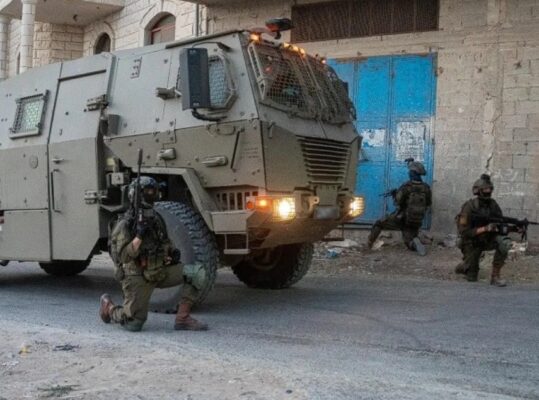
On October 20, the Israeli occupation army announced a military exercise involving gunfire and explosions in the occupied West Bank.
According to an Israeli report carrying the military announcement, it was scheduled to begin during the midday hours that day and continue until the midday hours of October 21.
The occupation army said the drills would involve increased movements of soldiers, aircraft and military vehicles, as well as gunfire and explosions.
It said these activities would be “part of the training rather than indications of an actual security incident.”
The military added that the drills would improve “the division’s readiness” for what it described as “defense and counterterrorism missions.”
Israeli live-fire training in Palestinian residential and agricultural areas has long endangered civilians, particularly in the Jordan Valley.
A May 16, 2026 report carried by WAFA described the continued use of military designations to restrict Palestinian communities while facilitating colony expansion.
The National Bureau for Defending Land and Resisting Colonies, citing Haaretz, said the army had reduced parts of closed military training zones to legalize colonial outposts and expand existing colonies. It said the army continued seeking to remove Palestinian communities, claiming they obstructed military training.
The bureau also reported demolitions and displacement in the Jordan Valley and Masafer Yatta, alongside new illegal colonial outposts in the same areas. It documented 140 military seizure orders issued under stated security needs between 2023 and 2025.
The bureau said 81 percent of these orders served colonies and outposts through road and connectivity projects. These projects restricted Palestinian access to agricultural land.
Explosive remnants remain lethal after drills end. Documented victims include children and shepherds killed or seriously injured in areas used for military training.
On February 17, 2026, WAFA reported that an explosion involving unexploded Israeli military munitions killed a Palestinian child and seriously injured two others in the Jordan Valley.
A separate report identified Mohammad Ibrahim Sleem Abu Dallakh, 13, as a child who died from injuries sustained in the explosion.
Ahmad Ghawanma, head of the al-Jiftlik Municipality, said the explosion near Furush Beit Dajan killed one child instantly and critically injured two others. He said Israeli occupation forces then prevented residents from approaching the site.
Local sources said the children, from al-Jiftlik, were gathering Akkoub (Gundelia) plants in the hills of Furush Beit Dajan. Israeli forces were conducting a military exercise nearby at the time, they said.
On September 27, 2023, Israeli soldiers conducted live-fire drills in and around the al-Farisiyya community in the northern Jordan Valley. Beginning early that morning, dozens of soldiers carried out simulations with live ammunition across several areas.
On May 16, 2023, live-fire military training caused fires across extensive Palestinian grazing land and cultivated farmland in the northern Jordan Valley.
Mo’taz Bisharat, a Palestinian official monitoring Israeli colonial activities in Tubas governorate, identified the affected areas as Jabaris, Khallet Al-Badd and al-Maleh. He said crops had burned.
In March 2018, the Israeli human rights organization B’Tselem documented infantry and tank exercises, mortar fire and the use of live ammunition near Palestinian homes and on farmland.
It recorded at least six exercises near residential areas in the preceding months. Two were conducted between homes. Some took place without advance warning to residents.
A report published on February 7, 2018, documented Israeli tanks destroying eight dunams of chickpea crops in al-Farisiyya during live-fire training. Agricultural Department head Majdi Odah described the crops on the affected land as almost completely destroyed.
Farmer Ziad Sawafta, whose 22-dunam holding included the damaged area, said soldiers also destroyed 150 meters of irrigation pipes.
B’Tselem separately documented mortar fire approximately 100 meters from homes in al-Farisiyya on February 5. The shelling damaged groves. It also reported that tanks and other armored vehicles trampled crops. During exercises, farmers could not tend their fields and shepherds could not reach pastureland.
On July 22, 2017, Odai Aziz Khalil Nawaj’a, 17, from Khirbet Ibzigh near Tubas, died at the Turkish Hospital in Tubas. An explosive left by soldiers during military drills had detonated near him. The report documented repeated live-fire training involving explosives around the community.
Military firing-zone designations have compounded these risks and restricted Palestinian access to land.
In a report published on July 4, 2017, the UN Office for the Coordination of Humanitarian Affairs (OCHA) said Israel had designated approximately 18 percent of the occupied West Bank as firing zones since the 1970s. At the time, these zones covered nearly 30 percent of Area C.
The report identified 38 Palestinian herding communities, home to more than 6,200 people, within those zones. Many of the communities predated the designations.
OCHA documented repeated temporary displacement for military exercises. It warned that these practices, alongside demolitions and other restrictions, created a coercive environment. This placed residents at risk of forcible transfer.
In June 2015, a Ma’an television report documented severe injuries suffered by Qoteiba Sawafta, nine, from an Israeli explosive in Tubas. A treating doctor said burns covered 30–40 percent of his body. The report described frequent Israeli live-fire training and the danger of ammunition left behind. Qoteiba’s father did not know when the explosive had been left near their home.
In November 2014, Ahmad Abdul-Rahman Sawafta, 44, a father of five, died after an explosive detonated while he was herding cattle near Bardala in the northern Jordan Valley. The explosive had been left during military training.
A report published on October 1, 2014, documented serious injuries to Malek Abu Dayya, 12. An explosive left by Israeli soldiers during training detonated as he herded his family’s sheep in the al-Manshiya area of Tuqu town, southeast of Bethlehem. Malek’s brother Ali, 11, sustained minor burns in the same explosion.
In August 2014, Mohammad Mo’tasem Abu Eshtayya, 17, was killed and his brother Yousef injured when an Israeli explosive detonated while they were herding sheep near Tubas. The grazing land was described as an area frequently used by the army for training with live ammunition, explosives and shells. A subsequent report described Yousef’s injuries as serious.
The documented deaths, serious injuries and agricultural destruction reveal the consequences of conducting live-fire training in areas where Palestinian families live and work.
Palestinian medical sources, local officials and residents documented the deaths, serious injuries and agricultural destruction. B’Tselem also documented training near homes without advance warning.
B’Tselem described repeated military exercises as part of a policy making life unbearable in Palestinian communities and pressuring residents to leave. Its findings included training between homes and exercises without advance warning. Such exercises, and the lethal explosives left behind, endanger Palestinian families and show disregard for their safety and livelihoods.
Unexploded ammunition prolongs the danger after soldiers withdraw, threatening families returning to their homes, fields and pastureland.
The casualties detailed in this report occurred in earlier incidents and are not attributed to the newly announced drills.
