
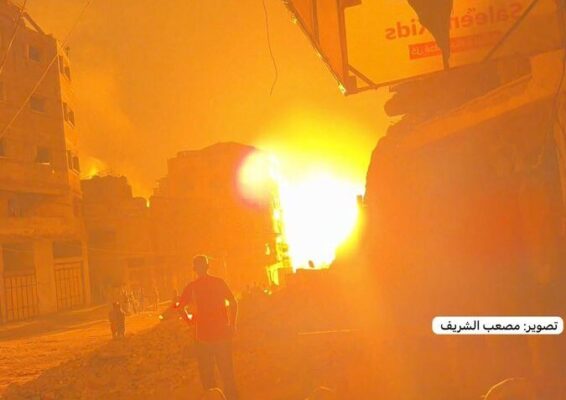
Three Palestinians were killed and dozens were injured Wednesday evening as Israeli drones, artillery, and armored units carried out new attacks across the Gaza Strip, in yet another violation of the declared “ceasefire.”
The strikes came as humanitarian agencies warn that Gaza’s population remains trapped in a deepening genocide marked by relentless bombardment, repeated displacement, and the collapse of essential services.
Medical teams said hospitals across the Strip received three killed Palestinians and twenty‑nine wounded over the past twenty‑four hours, though emergency workers noted that the real number of injured is likely higher, with many victims unable to reach medical facilities due to destroyed roads and ongoing Israeli fire.
At the Shifa Hospital in Gaza City, doctors confirmed the killing of Mohammad al‑Anqar and the injury of three others — one critically — after an Israeli drone fired a missile at a Palestinian man and several passersby near the intersection of Ahmad Abdul‑Aziz Street and Abdul‑Qader al‑Hassani Street in the al‑Rimal neighborhood.
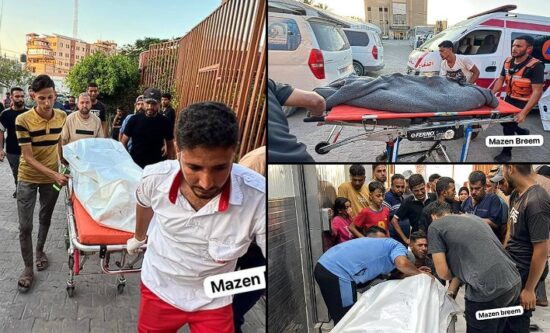 Witnesses said the strike hit a busy street where residents were attempting to move between damaged homes and makeshift shelters.
Another Palestinian was injured after an Israeli military quadcopter drone opened fire on the Shuja’iyya neighborhood, east of Gaza City.
In addition, seven Palestinians were wounded in an Israeli airstrike that hit the Shati refugee camp, west of Gaza City.
It is worth mentioning that the army carried out airstrikes targeting building in the Shati’ refugee camp during the day and at night.
In southern Gaza, two Palestinians — Anas Nimir al‑Basyouni and Mohammad Suleiman al‑Abed — were killed and twelve others wounded when an Israeli drone targeted the area around Street 5 in the al‑Mawasi district west of Khan Younis, in southern Gaza.
Regional outlets, including Al‑Jazeera Arabic, reported that the strike hit a zone Israel had previously labeled a “humanitarian area,” which has nonetheless been bombed repeatedly, forcing displaced families to relocate under fire.
Israeli artillery also shelled the eastern parts of al‑Qarara, northeast of Khan Younis, while armored vehicles opened heavy fire toward neighborhoods southwest of the city.
Gaza reporters documented additional explosions caused by controlled demolitions carried out by Israeli units in central Khan Younis, part of a pattern of systematic destruction of homes and civilian infrastructure despite the ceasefire framework.
Hospitals throughout Gaza continue to operate under extreme strain. Medical staff say fuel shortages, damaged roads, and repeated Israeli attacks near medical facilities are preventing ambulances from reaching wounded civilians.
Doctors warn that many patients are dying from injuries that would otherwise be treatable if hospitals had reliable electricity, surgical supplies, and safe access routes.
Recent statements from UN humanitarian agencies highlight the severity of the situation. In its latest update, OCHA said Israeli military restrictions and repeated security incidents are “severely impeding humanitarian access,” noting that aid convoys attempting to reach northern and central Gaza face delays, denials, and direct threats to staff safety.
UNRWA, in its most recent public briefing, warned that conditions remain “catastrophic,” citing widespread destruction, repeated displacement, and the near‑total collapse of water, sanitation, and health services.
UN officials stressed that civilians and civilian infrastructure must be protected under international law, and that ongoing Israeli strikes and movement restrictions are incompatible with any meaningful ceasefire.
The cumulative toll of the genocide in Gaza has now reached 73,335 Palestinians killed and 174,052 wounded since October 7, 2023, the Ministry of Health in Gaza said.
Since the “ceasefire” announced in October 2025, at least 1,209 Palestinians have been killed and 3,943 wounded, and 803 bodies have been recovered from destroyed areas.
Civil defense teams say many victims remain trapped under debris or in open streets where rescue crews cannot reach them due to continued Israeli fire and the collapse of emergency response capacity.
