
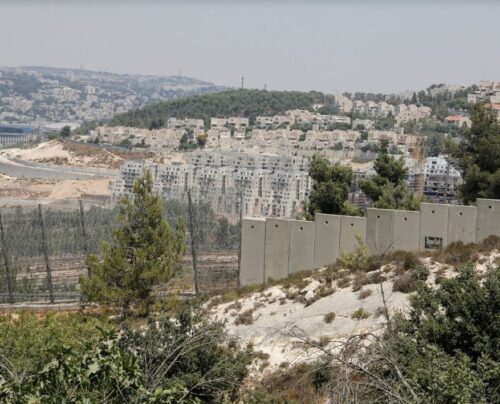
Israeli occupation authorities are advancing a comprehensive network of colonial projects across the northern occupied West Bank, aimed at transforming the geographic landscape through the establishment of new colonies, expansion of existing colonies, and construction of extensive colonial road systems that fragment Palestinian towns and villages.
According to the National Bureau for the Defense of Land and Resistance to Colonization, these plans represent a coordinated effort to consolidate permanent Israeli control over strategic areas between Jenin, Nablus, and the Jordan Valley.
The report details the advancement of 18 colonies, including “Yahnit” on the lands of Arraba in Jenin District, and “Rosh HaAyin Mizrahit” on the lands of Deir Ballut and az‑Zawiya in Salfit District.
Several colonial outposts and grazing farms are undergoing “legalization” and integration into Israel’s official settlement master plan.
New projects between Nablus and Jenin include a colonial road linking the Homesh colony to the Jordan Valley, effectively disrupting geographic continuity between the two Palestinian districts.
The plan also involves expanding the Sanur colony and surrounding outposts into a settlement belt designed to eliminate Palestinian territorial contiguity in the northern West Bank.
Planning maps reveal a major colonial road connecting Homesh and “Shuva Yisrael” to “Shegit Yehuda” in the Jordan Valley, constructed over thousands of confiscated dunams belonging to residents of Beit Imrin and Yasid northwest of Nablus.
The road extends toward Jaba’ and Siris south of Jenin, further isolating Jenin from Nablus. The so‑called “Higher Settlement Council” has approved a plan to rebuild and expand Sanur, adding 126 permanent housing units around the historic fortress, alongside private homes and multi‑story buildings funded by the Israeli government.
The report documents intensified expansion in the “Shaked–Reikhan” colonial bloc west of Jenin, which includes Shaked, Hananit, Reikhan, and Tel Menashe.
These colonies are extending their built‑up areas onto Palestinian lands classified as Areas A and B, while linking the Shavei Shomron colony to bypass roads that enable colonizers to travel toward the Jordan Valley and Homesh without passing through Palestinian communities.
Additional colonial roads are planned, including a route connecting Mount Ebal to Homesh via Tarsala and the Sanur military camp, terminating at Dotan; another linking Mount Salama in Raba to the “Noa” colony near the Arab American University and then to Dotan; and a road connecting the Ganim and Kadim colonies to the al‑Jalama military roadblock.
Another route will link these colonies to “Noa,” while a separate road is planned for a new colony near the village of Faqou’a.
The report highlights a rapid Israeli plan to seize Mount Ebal north of Nablus by establishing a grazing and residential colonial outpost intended to become a permanent colony.
The outpost’s nucleus was established in March 2026 with support from the “Northern West Bank Settlements Council” and the colonial organization “Amana.”
Mobile homes and heavy equipment continue to be brought in to expand infrastructure, implementing a May 2025 Israeli cabinet decision to “legalize” and establish 22 new colonial sites across the West Bank, with Mount Ebal designated as a priority location.
Israeli authorities are also employing biblical narratives promoted by Israeli archaeological groups to claim the presence of an “altar” in the Barnat area of Mount Ebal, framing the site as a Jewish religious and tourist destination.
This narrative is used to justify the seizure of surrounding lands under the pretext of “protecting antiquities.” Control of Mount Ebal, the highest peak in the Nablus mountain range, grants the Israeli military strategic oversight over Nablus and its northern and eastern villages, and is linked to the broader network of colonial roads extending toward Homesh and Sanur.
The report further documents ongoing Israeli efforts to seize the al‑Baqi’a plain east of Tubas in the northeastern West Bank by destroying water lines that irrigate thousands of dunams of farmland.
This is part of the “Crimson Thread” project, which aims to construct a military road and separation barrier across Palestinian lands.
Israeli bulldozers have been leveling agricultural areas for months, destroying crops, trees, and irrigation networks, threatening the livelihoods of hundreds of farmers and pushing them toward forced displacement.
Initial data indicate that approximately 24,000 dunams belonging to around 300 farmers are now at risk of drying out and becoming unusable — nearly one‑quarter of the 96,000‑dunam al‑Baqi’a plain. The remaining lands face similar risk as bulldozing continues.
The “Crimson Thread” project represents a significant step toward isolating the Jordan Valley from the rest of the West Bank and tightening Israeli control over the region.
The report recalls that Israeli daily Haaretz revealed in November 2025 that the project includes a 22‑kilometer‑long, 50‑meter‑wide military road and separation barrier stretching from Ein Shibli in the central Jordan Valley to the Tayasir military roadblock.
Israel issued land‑seizure orders for 1,042 dunams and commenced bulldozing operations that will isolate thousands more.
Financially, the report notes that Israeli Finance Minister Bezalel Smotrich is advocating for hundreds of millions of shekels in new allocations for colonies before the current government’s term ends, with mechanisms to ensure these funds remain binding for future administrations.
His plan includes increasing “Jewish identity” allocations by 200 million shekels through 2028, in addition to previously approved budgets such as 82 million shekels for the “Jewish Identity Directorate” and 60 million shekels for “Jewish Culture,” alongside hundreds of millions for ministries of heritage, traditions, and national missions.
Smotrich is also advancing two decisions to expand “national priority areas” to include colonies in the Jordan Valley and those near Gaza, granting them additional economic incentives and tax exemptions.
Haaretz reported that at least one billion shekels remain unused in coalition funds, along with 1.3 billion shekels officially allocated for local authorities but partially used to meet coalition party demands.
The report states that Israel’s early parliamentary election campaign has prompted right‑wing leaders to escalate rhetoric on colonization and the West Bank.
Smotrich, who also serves as a minister in the Israeli army and heads the Religious Zionism party, declared at a conference of colonial leaders that his goals for the next government include displacing Palestinians, canceling the Oslo Accords, and moving toward annexing the West Bank — describing annexation as the “long‑term solution.”
He also called for dismantling the idea of a Palestinian state and expanding the “colonization revolution” into the Negev and Galilee.
Former Israeli Prime Minister Naftali Bennett joined the election rhetoric, asserting that Area C — roughly 60% of the West Bank — “will be part of Israel,” while Areas A and B would remain under limited Palestinian self‑rule, signaling his rejection of a Palestinian state.
The report concludes with weekly documented field violations across the occupied West Bank, including colonizer invasions of Bedouin communities near al‑Khan al‑Ahmar in occupied Jerusalem, agricultural destruction in Hebron District, attacks on farmers and homes in Nablus District, and assaults on water infrastructure and vehicles in the northern Jordan Valley.
These violations include land seizures, home demolitions, destruction of crops, road closures, and direct assaults on residents — part of an ongoing pattern of Israeli military and colonizer actions aimed at consolidating control over Palestinian land.
