
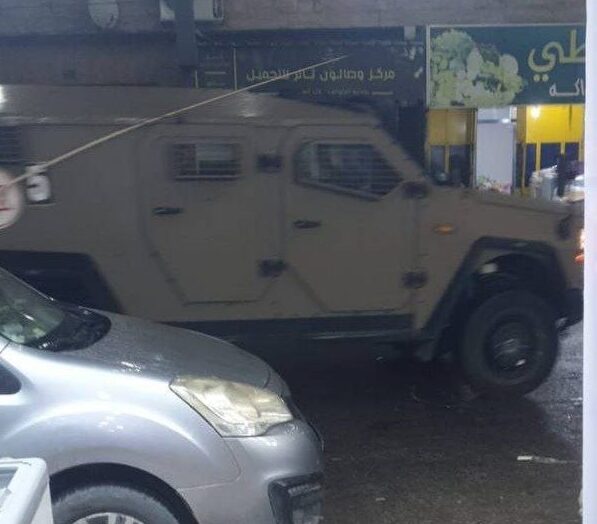
Israeli occupation forces continued widespread invasions across the occupied West Bank on Monday, destroying infrastructure, breaking into homes, and tightening military restrictions in multiple districts, including occupied Jerusalem, Ramallah in the central West Bank, Bethlehem and Hebron in the southern West Bank, Nablus in the northern West Bank, and Tulkarem in the northwestern West Bank.
Israeli forces invaded the town of Rafat, northwest of occupied Jerusalem, where military bulldozers destroyed a paved secondary road.
The destruction further restricted movement in an area already surrounded by Israeli military installations and expanding colonies.
The Jerusalem district has faced intensified military pressure, including road destruction, land seizures, and movement restrictions.
 In the central West Bank, the army invaded several towns and villages west and north of Ramallah, including Ni’lin, Shuqba, Qibya, and Budrus, as well as Surda north of the city and Silwad northeast of the city, where soldiers abducted a wounded child, Mohammad Yasser Rajeh, and a young man, Abdul‑Aziz Faqqu’i. Local sources said soldiers also fired concussion grenades and toxic gas canisters during the invasions.
Communities in the Ramallah district, particularly those near the Annexation Wall and military roadblocks, have experienced near‑daily invasions and escalating military presence.
In the southern West Bank, Israeli forces invaded the villages of Jouret ash‑Sham’a, Wadi an‑Nis, and Um Salamuna south of Bethlehem, breaking into several homes and searching them.
Media sources said soldiers broke into the home of Issa Ahmad Issa in Jouret ash‑Sham’a and later broke into the home of Walid Mousa Abu Hammad in Wadi an‑Nis. No abductions were reported.
The army also closed the road connecting Tuqu’ and Janata east of Bethlehem by sealing it with an iron gate. The Bethlehem district has seen repeated road closures and home invasions, particularly in communities south and east of the city.
In Hebron in the southern West Bank, soldiers invaded the town of Doura, south of the city, and abducted a young man.
in addition, Israeli soldiers assaulted a Palestinian family and forcibly removed them from their home in the village of Al‑Deirat in Masafer Yatta, south of Hebron, shortly before military bulldozers moved in to demolish the property.
The Hebron district continues to face frequent invasions, home searches, and movement restrictions imposed by the army and illegal paramilitary Israeli colonizers.
In the northern West Bank, Israeli forces invaded the town of Qusra, south of Nablus, breaking into and searching several homes, detaining residents for interrogation, and converting one home into a military post.
During the invasion of Beit Furik, east of Nablus in the northern West Bank, Israeli soldiers assaulted and injured two young Palestinian men.
 The Nablus district continues to face heavy military activity and frequent attacks by illegal paramilitary Israeli colonizers, especially in villages south of the city.
The most extensive escalation occurred in Tulkarem in the northwestern West Bank, where the army expanded its operations in and around Tulkarem Refugee Camp.
Military bulldozers closed internal roads and routes connecting the camp with the nearby Thannaba neighborhood by installing earth mounds, while large numbers of military vehicles and infantry units spread throughout the area.
Journalists reported that the army sent additional reinforcements, including bulldozers, through the “Nitzanei Oz” military roadblock west of the city before deploying inside the camp amid continuous drone surveillance.
Residents said soldiers forced several families to evacuate their homes near Ajeal Hall Street, the Hanoun neighborhood, and the western parts of Thannaba, claiming they intended to carry out explosive demolitions inside the refugee camp.
The Tulkarem district has been under continuous military assault for 463 consecutive days, with Tulkarem and Nur Shams refugee camps facing repeated invasions, home demolitions, and a prolonged siege that has deepened the humanitarian crisis and displaced large numbers of residents.
