
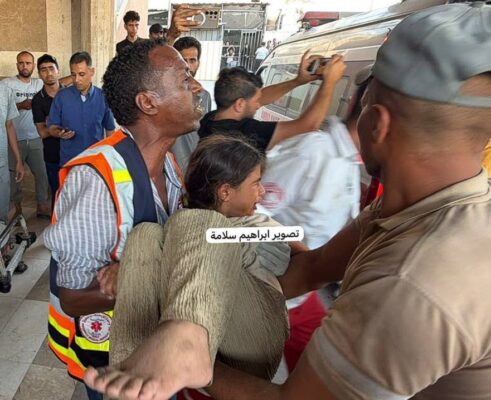
Israeli occupation forces killed six Palestinians and wounded several others across the Gaza Strip during the past twenty‑four hours, as violations of the so‑called ceasefire continued for the two hundred and eighty‑seventh consecutive day.
Attacks were reported in Gaza City, Jabalia, Khan Younis, and Rafah, and included artillery shelling, drone strikes, live fire, and demolition operations targeting homes, civilian facilities, and tents sheltering displaced families.
In Khan Younis, medical staff at Nasser Hospital confirmed the killing of fifty‑nine‑year‑old Mufid Abdul‑Hamid Abu Al‑Einein, who was shot inside his tent in the Bir 19 area of Al‑Mawasi.
Several displaced residents were also wounded when Israeli forces opened heavy fire on tents in the same district. Gunfire also struck a tent belonging to the Abu Razeq family inside the Ahel Al‑Kheir 2 displacement camp, injuring multiple residents, including children, with one child reported in extremely critical condition.
Civil defense teams documented two additional injuries on Thursday morning after Israeli forces opened fire on tents in the Al‑Burj area of Al‑Mawasi.
Local sources reported Israeli helicopter gunfire over northern Gaza and eastern Gaza City, while military vehicles fired on tents southwest of Khan Younis, causing widespread panic among displaced families.
In Rafah, a resident was injured by shrapnel from an Israeli tank shell near the Muawiya Mosque in Al‑Mawasi.
In northern Gaza, Israeli aircraft bombed a group of residents near Al‑Yaman Al‑Sa’eed Hospital in Jabalia refugee camp, killing one person and injuring others, including children.
A separate drone strike critically wounded a young man in the Al‑Fallujah neighborhood west of the refugee camp.
In addition, medical sources at the Shifa Hospital in Gaza City reported the death of thirty‑four‑year‑old Abdullah Ahmad Hassan, who succumbed to wounds sustained in a previous Israeli attack.
Israeli occupation forces carried out demolition operations in the eastern part of the Gaza city, accompanied by heavy fire east of the Zeitoun neighborhood. Artillery shelling struck the Sanafur Junction in Al‑Tuffah, along with additional strikes in Zeitoun.
At dawn on Wednesday, Israeli military vehicles, including a bulldozer, advanced roughly one hundred and fifty meters near Dawla Junction southeast of Zeitoun, firing live rounds and artillery shells while conducting earth‑moving operations.
Witnesses reported loud explosions throughout the night as Israeli forces pushed concrete barriers marking the so‑called yellow line westward toward Salahuddin Street.
Furthermore, Israeli artillery fire and live rounds also struck areas east of Deir al‑Balah in the central Gaza Strip.
In related news, Israel released thirty‑five Palestinian detainees on Wednesday through the Karem Abu Salem (Kerem Shalom) crossing. The International Committee of the Red Cross transferred them to Nasser Hospital for medical evaluation.
Israel periodically releases small groups of detainees under a prisoner‑exchange agreement brokered by Egypt, Qatar, Turkey, and the United States, which took effect on October 13, 2025. Under this agreement, Israel has released approximately one thousand seven hundred detainees from Gaza.
Rights groups report that more than 9.600 Palestinians remain imprisoned in Israel, including around three hundred and fifty children and eighty‑four women, amid widespread reports of torture, starvation, medical neglect, and abuse.
Furthermore, Al‑Jazeera’s investigative unit reported that new satellite analysis shows Israeli military bulldozers carving long earthen barriers and new routes across Gaza, effectively reshaping internal boundaries months after the October 2025 ceasefire.
According to Al‑Jazeera, imagery from Planet Labs documents roughly thirty kilometers of non‑continuous berms across multiple governorates. These lines often follow—and in several areas extend beyond—what Israel calls the yellow line, the temporary deployment zone established after the ceasefire. Construction accelerated sharply beginning in November 2025.
Israel has expanded its control of Gaza from 53% under the October ceasefire agreement to an estimated nearly 70%, steadily pushing the “yellow line” westward and seizing more Palestinian land.
In Gaza City’s Zeitoun neighborhood, Israeli forces bombed and shelled residential… pic.twitter.com/Gagyyt79lb
— Drop Site (@DropSiteNews) July 23, 2026
Al‑Jazeera describes these earthworks as physical partitions rather than symbolic markers, noting that bulldozers have cut through agricultural land, paved roads, and residential areas, creating segmented but coordinated barriers.
The longest documented stretch runs approximately nineteen kilometers from eastern Khan Younis toward Gaza City’s Zeitoun neighborhood. Additional segments include four kilometers in Rafah, eight kilometers in Khan Younis, seven kilometers in Deir al‑Balah, five kilometers in Gaza City, and five and a half kilometers in northern Gaza.
Al‑Jazeera also cites UN OCHA data showing that Israel has expanded what humanitarian agencies call the orange zone, an area requiring prior military coordination for aid movement.
This zone now covers 64.9 percent of Gaza, up from 53 percent under the earlier yellow‑line configuration. The expansion has repeatedly obstructed access to displaced communities and essential services, including waste‑management sites and UNRWA facilities.
Israeli activity near these zones recently isolated eleven displacement sites in northern Rafah, cutting off roughly one thousand six hundred people between July 6 and 13.
Satellite images reviewed by Al‑Jazeera show widespread destruction east of the yellow line, including flattened neighborhoods, razed farmland, and newly carved military roads.
Al‑Jazeera concludes that while political negotiations remain slow, the Israeli military is rapidly altering Gaza’s geography, raising urgent questions about movement, the return of displaced families, and the feasibility of rebuilding areas east of the newly imposed barriers.
On Tuesday, twelve Palestinians were killed in Israeli airstrikes, including six members of one family, as Israeli occupation forces continued to violate the ceasefire agreement reached in October 2025.
Hospitals in Gaza received six fatalities in the past twenty‑four hours, including three killed directly by Israeli attacks, two who died from previous wounds, and one recovered from under rubble. Six additional residents were injured.
Since the “ceasefire” agreement on October 11, 2025, Israeli attacks have killed 1,185 Palestinians and injured 3,816, with 803 bodies recovered from rubble. Since October 7, 2023, the cumulative toll has reached at least 73,311 killed and more than 173,924 wounded.
Civil defense teams say more victims remain under debris and in open areas where rescue access is impossible due to ongoing Israeli fire.
