
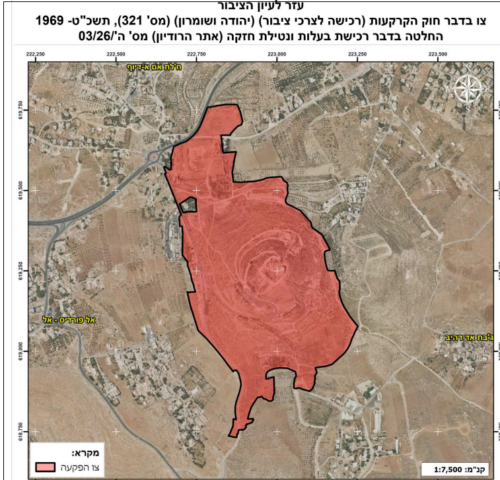
Israeli occupation authorities issued a new military order on Tuesday to seize 300 dunams of Palestinian‑owned land in the Jabal al‑Freydis area on the lands of Arab al‑Ta’amra, east of Bethlehem in the southern occupied West Bank, under the pretexts of “public use” and “developing the archaeological site.”
Moayyad Shaaban, head of the Wall & Colonization Resistance Commission, said the order is the third land‑seizure directive issued by Israel since the beginning of 2026, forming part of an accelerated policy aimed at imposing administrative and legal control over Palestinian land and diverting it to serve colonial settlement expansion.
He stressed that the occupation continues to exploit its system of military orders to strip Palestinians of their property.
Shaaban explained that the new order is the sixth in recent years targeting Palestinian archaeological and heritage sites, including the Akhliyus site in Jericho in the eastern West Bank, Deir Samaan and Deir Qal’a in Salfit in the central West Bank, the Sebastia site in Nablus in the northern West Bank, and the Nabi Samuel area north of occupied Jerusalem.
|Colonizers Torch Fields, Seize Livestock in West Bank Attacks|
He said the pattern reflects a growing Israeli strategy of using historical and archaeological narratives as tools to seize land and entrench colonial annexation across the occupied Palestinian territory.
The official added that in 2024, Israeli authorities had already declared 171 dunams surrounding the Herodion site as “state land,” and the new order expands the takeover by adding more than 130 dunams, bringing the total seized area to 300 dunams.
|Colonizers Intensify Arson, Assaults, and Land Seizures|
This, he said, reveals a gradual, systematic plan to assert full control over the entire geographic area of the site and its surroundings through layered legal classifications designed to justify land confiscation.
Shaaban emphasized that Israel’s use of “expropriation” in the occupied West Bank is one of the most dangerous tools employed to impose de facto annexation, relying on unilateral military and administrative measures that violate international law, including the Fourth Geneva Convention and relevant UN resolutions.
He noted that targeting Palestinian archaeological and heritage sites goes beyond land seizure, forming part of a broader attempt to reshape the historical and cultural landscape, detach these sites from their Palestinian context, and integrate them into the colonial settlement project as tourist and settlement hubs that reinforce Israeli narratives.
