
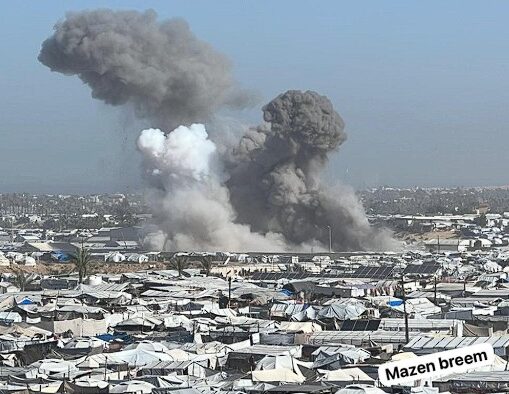
Israeli drones, artillery units, naval vessels, and armored vehicles carried out extensive attacks across the Gaza Strip on Friday, injuring approximately fifteen Palestinians in continued violations of the “ceasefire” agreement.
The assaults targeted hospital staff, residential areas, displacement zones, and coastal regions, while the United Nations warned that conditions for women and pregnant mothers have reached catastrophic and life‑threatening levels.
In northern Gaza, medical teams confirmed that an Israeli combat drone fired toward the courtyard of Kamal Adwan Hospital in Beit Lahia, wounding three Palestinians.
The army also dropped several small explosive devices near the hospital’s maintenance section, injuring three employees working in the guard and maintenance units.
The attack caused widespread panic among displaced families sheltering inside the hospital grounds, which have been repeatedly targeted and continue to operate under severe shortages of staff, equipment, and electricity.
Local sources reported that Israeli armored vehicles shot and injured a Palestinian woman in the Al‑Fallujah area west of Jabalia refugee camp.
In Gaza City, Israeli drones fired intensively toward homes east of the Tuffah neighborhood, particularly near the “yellow line,” coinciding with the advance of Israeli military vehicles inside the area. Residents described continuous gunfire that forced families to relocate between already overcrowded shelters.
One of the most brutal scenes in human history has been leaked.
An Israeli soldier filmed this clip using a drone camera while proudly boasting about the destruction of all homes in Gaza.
A moment the world must never forget. pic.twitter.com/gH3zVEHLeF
— Muhammad Mazen (@mhmd_s09) July 10, 2026
In central Gaza, several Palestinians were injured when Israeli forces opened fire east of the Al‑Bureij refugee camp. Additional injuries were documented in the Nuseirat refugee camp and the nearby town of Mughraqa, where residents were struck by live fire while attempting to move between displacement sites.
Israeli artillery also shelled areas east of Deir Al‑Balah, damaging homes and tents used by displaced families and forcing dozens to flee again.
In southern Gaza, the Palestinian Red Crescent confirmed that at least one Palestinian was shot by Israeli forces in the Al‑Amal neighborhood of Khan Younis.
Israeli armored vehicles also opened heavy fire in eastern Khan Younis, while naval vessels fired toward the coast of Khan Younis and the central Gaza shoreline.
Artillery units shelled areas northwest of Rafah, in Gaza’s southernmost area, adding to the destruction in neighborhoods already devastated by previous invasions.
Residents in eastern Gaza City reported that Israeli forces detonated several residential buildings, part of ongoing demolition operations inside the “yellow line,” where Israeli troops continue to impose severe restrictions on movement, humanitarian access, and the entry of goods, aid, and medical supplies.
Local sources said these demolitions have intensified in recent days, further displacing families who had already lost their homes earlier in the war.
Meanwhile, the Israeli army said it carried out an airstrike on Thursday in southern Gaza, killing Yahia Sa’id Mohammad Hamdan, whom it described as a commander in an elite unit of the armed wing of Hamas.
The army alleged that Yahia had led the attack near Re’im on October 7, 2023, and that he had recently been involved in planning operations against Israeli forces and attempting to rebuild Hamas’ military capabilities. These claims could not be independently verified.
Friday’s attacks followed the killing of eight Palestinians by Israeli fire and shelling in several parts of the Gaza Strip the previous day. Journalistic sources in Gaza reported that Hamas spokesperson Hazem Qassem survived an apparent assassination attempt when an Israeli strike targeted a vehicle west of Gaza City.
🚨 HORRIFYING: An Israeli drone shot a Palestinian mother, leaving her quadriplegic. One bullet changed her life forever. pic.twitter.com/MchRtXyNoY
— Gaza Notifications (@gazanotice) July 10, 2026
The Palestinian Health Ministry in Gaza said Israeli violations of the “ceasefire” that began on October 11, 2025, have killed at least 1,094 Palestinians, injured 3,507, and resulted in 799 bodies recovered from destroyed homes and structures.
Since the beginning of the genocide on October 7, 2023, the cumulative toll has risen to at least 73,120 Palestinians killed and more than 173,615 injured, reflecting the immense human cost of the ongoing Israeli assault.
🚨An Israeli soldier films himself destroying civilians’ belongings in Gaza, then proudly posts the video under the caption “Dancing in Gaza.” pic.twitter.com/gszH2ZoNT2
— Gaza Notifications (@gazanotice) July 10, 2026
The United Nations stated that the humanitarian and health situation for women and pregnant mothers in Gaza has reached catastrophic levels.
UN agencies report that displaced women in overcrowded shelters face acute malnutrition, lack of prenatal and postnatal care, and severe shortages of medicines, clean water, and sanitation.
The collapse of primary healthcare services, combined with ongoing Israeli attacks and forced displacement, is sharply increasing risks of complications, miscarriages, and preventable deaths among mothers and newborns.
