
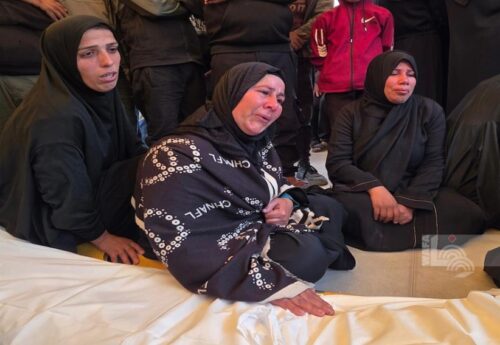
Two Palestinians were killed on Saturday when Israeli drones struck separate locations in the northern and southern Gaza Strip, as humanitarian conditions across the enclave continue to deteriorate despite a ceasefire announced four months ago.
Medical teams said the strikes targeted the Jabalia refugee camp in the north and the Qizan an‑Najjar area south of Khan Younis, killing two civilians.
The attacks occurred amid ongoing violations and continued instability in areas where displaced families remain without adequate shelter or aid.
Ceasefire Brings Little Relief to Displaced Families
The ceasefire has not translated into meaningful improvements for Gaza’s displaced population. Tents still line the outskirts of cities, aid deliveries remain severely restricted, and basic needs continue to grow faster than the limited assistance entering the Strip.
In the Mawasi area of Khan Younis, families who fled Rafah and other districts describe a daily existence shaped by fear, scarcity, and uncertainty.
Residents say the sounds of gunfire and military vehicles continue to echo through the area, undermining any sense of safety. One displaced mother said her son’s illness and the family’s deepening poverty have become constant burdens, with medicine and adequate food increasingly out of reach.
Israel deliberately targeted and disabled water desalination plants, causing severe crises that threaten our access to essential water.
We are suffering greatly from the shortage, especially during Ramadan, when the need for water is more urgent than ever.💔 pic.twitter.com/VfzaFAQtG6
— Haitham in Gaza 🇵🇸🍉 (@HaithamElmasri1) February 21, 2026
Another woman, Umm Mohammad, said the hardship of displacement has not eased since the ceasefire, leaving families trapped in a cycle of waiting — for aid, for stability, and for any sign that their situation might improve. She described a growing sense of exhaustion as overcrowded shelters and scarce resources push families beyond their limits.
Footage from the area shows families sleeping directly on the ground due to the lack of mattresses and blankets. In many tents, seven or more people share a cramped space with no privacy, no sanitation, and no stable access to water or electricity.
Ramadan Begins Under Severe Shortages
With the arrival of Ramadan, the struggle to secure food has intensified. In Khan Younis, local charity kitchens have become the primary source of iftar meals for thousands of families who have lost their homes and livelihoods.
Volunteers begin preparing simple meals early each morning, often relying on canned goods or limited ingredients. Many families fast the entire day only to break their fast with a single modest dish that does not meet basic nutritional needs.
Despite this, residents express gratitude for whatever food is available, knowing that the alternative may be going without any meal at all.
Aid workers say the number of trucks entering Gaza remains far below the levels outlined in humanitarian agreements. Instead of the roughly 600 trucks per day that were expected, only a fraction are allowed, leaving essential supplies — including tents, blankets, and equipment needed to clear rubble — largely unavailable. Hundreds of aid trucks remain stalled outside the Strip awaiting permission to enter.
The reduction in operations by numerous international organizations has further strained the relief system. Local charities and community kitchens have become the primary lifeline for thousands of families who cannot afford the limited goods available in markets, where prices have surged beyond reach.
Displacement Camps Face Water Shortages and Unsafe Conditions
In the Zeitoun neighborhood in southeastern Gaza City, new displacement sites have been erected on unprepared land through individual efforts. The camps lack proper infrastructure, and tents are packed tightly together.
Residents say obtaining water has become one of the most exhausting daily tasks. Because the camp sits in a low‑lying area, water access points are distant, forcing children and fasting adults to walk long distances to fill containers.
More than 900,000 displaced Palestinians are living in worn‑out tents, many unable to return to their homes due to ongoing restrictions and repeated ceasefire violations. Residents report that stray bullets occasionally reach the outskirts of the camps, adding to the sense of insecurity.
Basic goods in local markets remain prohibitively expensive, and residents say that while some non‑essential items have entered the Strip, essential supplies and heavy equipment needed to clear debris and improve shelter conditions remain scarce.
Health Sector Warns of Escalating Risks
Health officials warn that the situation is becoming increasingly dangerous. Dr. Mohammad Abu Afash, director of the Palestinian Medical Relief Society in Gaza, described widespread exhaustion, malnutrition, and a severe shortage of medicines and medical supplies.
The new Lancet study finds that total deaths were 1.71 times higher than reported by Gaza Ministry of Health as of Jan.
With same ratio it means total deaths are now 123,000.
Israel lied as always. Irrefutable.
Majority are civilians and kids.
— Daniel Lambert (@dlLambo) February 20, 2026
Shelters are severely overcrowded, creating ideal conditions for the spread of disease. Accumulated waste and the inability to bring in sanitation equipment have heightened health risks, particularly for children, who make up a large portion of the displaced population.
Abu Afash warned that declining food quantity and quality could lead to rising cases of malnutrition and anemia. He stressed that the current level of aid entering Gaza is insufficient to maintain even minimal health standards and called for the immediate entry of the supplies outlined in humanitarian agreements.
Casualty Figures Continue to Rise
Medical sources reported that in the past 48 hours alone, hospitals received 10 injured Palestinians, while the number of fatalities during that period remains under verification due to bodies still trapped under rubble and in areas unreachable by rescue teams.
Since the “ceasefire” announced on October 11, 2025, the number of Palestinians killed has risen to 612, with 1,640 injured, and 726 bodies recovered from destroyed areas.
The death toll from the genocide in the Gaza Strip has risen to 72,070 Palestinians, with 171,738 injured, the majority of whom are children, women, and elderly, since October 7, 2023.
A recent analysis published in The Lancet concluded that the actual number of Palestinians killed in Gaza is likely far higher than the official figures released by the Gaza Ministry of Health.
The study examined mortality patterns in large‑scale conflicts and compared them with Gaza’s reported casualty data, estimating that as of January, total deaths were approximately 1.71 times higher than the ministry’s confirmed count.
The new Lancet study finds that total deaths were 1.71 times higher than reported by Gaza Ministry of Health as of Jan.
With same ratio it means total deaths are now 123,000.
Israel lied as always. Irrefutable.
Majority are civilians and kids.
— Daniel Lambert (@dlLambo) February 20, 2026
The multiplier reflects both direct fatalities from bombardment and indirect deaths caused by the collapse of healthcare, sanitation, food systems, and other essential services.
Applying the same ratio to the ministry’s current official toll of 72,070 deaths suggests that the true number of Palestinians killed since October 2023 may exceed 123,000.
Public‑health experts note that in prolonged conflicts, indirect deaths — including those resulting from untreated injuries, infectious disease, malnutrition, dehydration, and the breakdown of medical infrastructure — often surpass the number of people killed directly by military strikes.
