
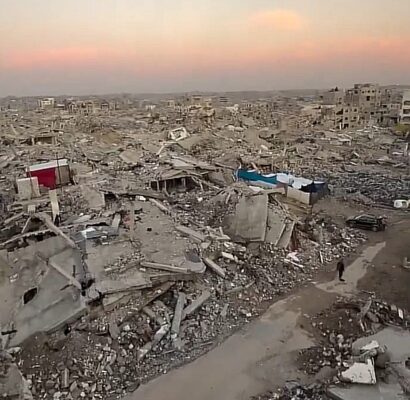
Two Palestinians were shot and killed by Israeli occupation forces on Monday near the Shuja’iyya courthouse in eastern Gaza City, in what local sources described as a new violation of the “ceasefire agreement” in place since October 10.
One of the victims was reportedly targeted by Israeli drone fire in the “Yellow Line” area of Shuja’iyya, while the second was shot by Israeli forces stationed near the courthouse. Both locations fall within zones designated for civilian movement under the terms of the ceasefire.
The Gaza Ministry of Health said the overall death toll from Israel’s assault on the Gaza Strip since October 7, 2023, has risen to 70,937 Palestinians, the majority of them women and children. The number of wounded has reached 171,192, while many victims remain trapped beneath destroyed buildings that rescue teams cannot access due to ongoing Israeli restrictions.
Over the past 48 hours, hospitals in Gaza received 12 bodies, including four people killed in recent attacks and eight recovered from the rubble.
Seven additional Palestinians were injured during the same period. Since the ceasefire took effect on October 11, Israeli violations have resulted in 405 deaths and 1,115 injuries, with 649 bodies recovered from collapsed structures.
Ceasefire violations and humanitarian deterioration:
Despite the “ceasefire,” Israeli forces continue to carry out attacks across the Gaza Strip. Regional media and humanitarian organizations reported Israeli artillery and helicopter fire west of Rafah and east of Khan Yunis on Monday, while Israeli drones continued to operate over civilian areas.
On Monday evening, Israeli occupation forces carried out a large‑scale demolition operation in Khan Yunis, in the southern Gaza Strip.
Media sources said Israeli soldiers detonated explosives inside several residential buildings in the eastern part of Khan Yunis, reducing them to rubble.
In the north of the Strip, Israeli artillery shelled eastern areas of Jabalia, while tanks opened fire toward the al‑Tuffah neighborhood in eastern Gaza City
The World Health Organization warned that Gaza’s humanitarian situation remains “extremely fragile,” with more than 100,000 children and tens of thousands of pregnant and lactating women at risk of acute malnutrition due to ongoing restrictions on aid entry. Gaza’s health system is functioning at less than half its capacity amid severe shortages of medicine, equipment, and fuel.
Municipal authorities in Khan Yunis also reported a sharp reduction in fuel supplies, hindering efforts to clear rubble and reopen roads in neighborhoods devastated by earlier Israeli attacks.
 Buildings collapsing under winter storms:
Civil defense teams in Gaza City said several damaged homes and buildings have collapsed in recent days due to heavy winter storms, including a three‑story structure in the Sheikh Radwan neighborhood where rescue crews pulled five survivors from the rubble.
At least 15 Palestinians have died this winter after weakened buildings gave way under rain and wind.
Ongoing blockade and reconstruction crisis
Israel continues to block the entry of construction materials, mobile homes, and essential supplies into Gaza, leaving thousands of families in unsafe, partially destroyed structures.
The United Nations estimates that 90 percent of Gaza’s infrastructure has been damaged or destroyed, with reconstruction costs exceeding $70 billion.
Humanitarian groups warn that without full implementation of the ceasefire — including unrestricted aid access — Gaza’s civilian population will continue to face life‑threatening conditions.
Doctors Without Borders warns of new restrictions:
Médecins Sans Frontières (Doctors Without Borders) warned that new Israeli regulations governing the registration of international NGOs could leave hundreds of thousands of people in Gaza without life‑saving medical care by 2026.
Under the new rules, the registration of international organizations may be revoked as early as January 1, threatening the ability of humanitarian groups to continue providing essential services.
In a statement, the organization said the measures would prevent humanitarian agencies — including Doctors Without Borders — from delivering basic medical services in Gaza and the West Bank.
It described the potential impact as a “real humanitarian disaster” for Palestinians, given the extensive destruction of Gaza’s health system after two years of war.
Doctors Without Borders urged Israeli authorities to ensure that international organizations can operate independently and without political interference.
The appeal comes as Gaza’s health sector faces near‑total collapse and requires support and facilitation, not additional restrictions.
Inas Abu Khalaf, the organization’s regional media officer, said the timing of the new regulations is “extremely troubling from a humanitarian perspective.” Speaking to Al Jazeera, she noted that the decisions come after two years of mass casualties and the near‑total destruction of Gaza’s medical and humanitarian infrastructure — a moment when the sector urgently needs greater access and support.
Abu Khalaf added that humanitarian operations are already facing severe challenges even before the regulations take effect, warning that the new, politically driven criteria will only worsen the situation.
She said the organization fears catastrophic consequences for Gaza’s besieged population.
She also stressed that the regulations are political in nature because they lack transparency and clarity, and do not align with humanitarian principles of independence, neutrality, and impartiality.
Doctors Without Borders has conveyed its concerns directly to Israeli authorities, including the Ministry of Community Affairs.
