
The United Nations Office of the High Commissioner for Human Rights (OHCHR) in the occupied Palestinian territory warned on Tuesday that Israel, the occupying power, has intensified its repression against journalists, human rights defenders, civil society activists, and both local and international NGOs.
The Office cautioned that this campaign is increasingly shrinking the space available to monitor and document violations, pursue accountability, and advocate for fundamental freedoms.
Crackdown on Journalists
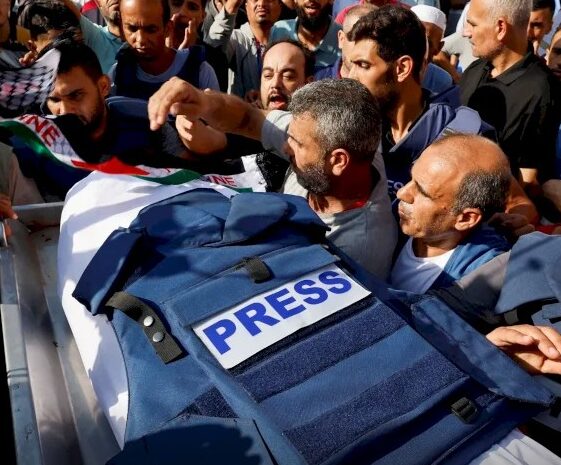
Between October 7, 2023, and December 14, 2025, OHCHR documented the killing of 289 journalists in Gaza during Israeli military operations, including incidents with strong indications of deliberate targeting, while during the same period the Palestinian Journalists’ Syndicate reported that Israeli forces abducted at least 202 journalists from Gaza and the West Bank, with 41 still held in detention as of October 31, 2025. As of that date, 41 remained in detention.
Most were held under administrative detention without charges or trial, which OHCHR described as arbitrary deprivation of liberty that exposes detainees to torture, ill‑treatment, and enforced disappearance. Since October 7, 2023, at least 85 Palestinians have died in Israeli prisons.
Ban on International Media Access
While Palestinian journalists face escalating threats, Israel continues to impose a blanket ban on independent access for international reporters to Gaza, alongside unjustified restrictions on foreign media in the West Bank.
In April 2024, Israel passed a law allowing authorities to shut down foreign media deemed a “national security threat.”
Shortly afterward, military orders forcibly closed Al Jazeera’s offices in Ramallah and banned its broadcasts.
Civil Society Under Pressure
OHCHR noted that the shrinking space for independent journalism is part of a broader crackdown on human rights defenders, anti‑occupation activists, and civil society organizations, which have intensified since October 7, 2023.
Israel continues to invoke its 2016 so-called “Counter‑Terrorism Law” and the “Emergency Defense Regulations of 1945” against Palestinian NGOs, using them to justify invasions of offices, restrictions on funding, and arrests of staff.
OHCHR emphasized that vague legal definitions and sweeping state powers have enabled unjustified restrictions on peaceful advocacy and mobilization.
International NGOs have also faced mounting obstacles. In March 2025, an inter‑ministerial Israeli decision effectively canceled the registration of all international NGOs operating in the occupied Palestinian territory, forcing them into a burdensome re‑registration process under restrictive new conditions.
OHCHR warned this has obstructed UN‑led humanitarian response in Gaza and undermined Palestinian civil society organizations that rely on cooperation with international partners.
Colonialist Expansion Condemned
The UN rights office stressed that repression of civil society is occurring alongside a dramatic escalation in colonialist expansion.
Israel recently approved plans to formalize 19 illegal colonies across the occupied West Bank, accelerating annexation and erasing Palestinian geography.
Saudi Arabia strongly condemned the decision. In a statement, the Foreign Ministry denounced Israel’s approval of the settlements as a violation of international law and UN resolutions.
The Kingdom renewed its call on the international community to assume responsibility in halting such violations and reaffirmed its firm position in support of the Palestinian people and their right to establish an independent state on the 1967 borders with East Jerusalem as its capital, in line with the Arab Peace Initiative and relevant international resolutions.
Settlement watchdogs warned that more than 500,000 colonizers already live in West Bank colonies and another 250,000 in occupied East Jerusalem.
The expansion, they said, makes a two‑state solution virtually impossible and entrenches apartheid conditions across the territory.
Shrinking Physical Space
Beyond restrictions on civic freedoms, OHCHR highlighted that Palestinians’ physical space is also being reduced. In Gaza, Israel confines most of the population to less than half of the Strip, surrounded by an arbitrary “redeployment line” where Israeli ground forces remain stationed.
In the West Bank, Israel has forcibly displaced Palestinians at unprecedented rates, emptying entire communities and paving the way for settlement expansion.
OHCHR said this amounts to a redrawing of geography and of the boundaries of what Palestinians are permitted to say or do in response.
In a statement, Ajith Sunghay, head of OHCHR in the occupied Palestinian territory said “These violations generate fear and despair, depriving Palestinians of any means to convey the reality of their lives to the world, to seek justice for decades of discrimination, violence, and repression, and to defend a future where their human rights are protected and upheld.”
