
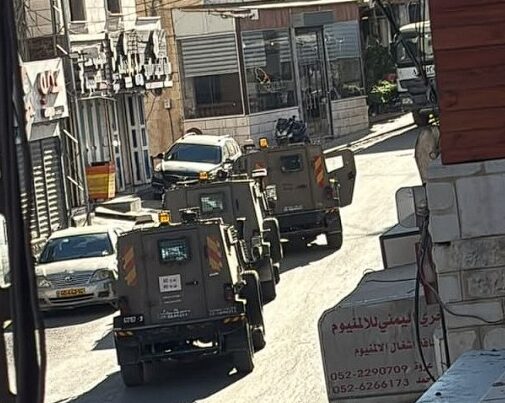
Israeli forces carried out extensive invasions and abductions across the occupied West Bank on Tuesday, storming towns, villages, and refugee camps in multiple districts while illegal paramilitary colonizers assaulted residents and accompanied military units during several operations.
In the Ramallah district in the central West Bank, a large Israeli force accompanied by a military bulldozer and colonizers invaded Beitunia to the west, roaming through its streets. Additional units invaded Deir Jarir to the east and Rantis to the west.
Local sources reported a gathering of soldiers and colonizers at the entrance of al Mughayyer, north‑east of Ramallah, where protests later erupted and Israeli troops fired gas canisters at residents. In Beitillu, west of Ramallah, colonizers surrounded several Palestinians and assaulted them.
In addition, the soldiers abducted four young men during invasions targeting the al Am’ari refugee camp south of Ramallah, the Um al Sharayet neighborhood in al-Bireh, and Beitillu.
The abducted men were identified as Rajab Ghannam, 25, from al Am’ari; Mohammad Badrain, 25, from Um al Sharayet; Mohammad Ibrahim Abu Ziyada from Beitillu, seized at a military roadblock near Ein Ayoub; and Mazen Radwan Rimawi from Beit Rima, north‑west of Ramallah, after troops broke into his home and ransacked its contents.
For the fourteenth consecutive day, Israeli forces continued to impose a full closure on Sinjil, north‑east of Ramallah, preventing entry and exit.
In occupied Jerusalem, Israeli forces invaded Anata north‑east of the city, while protests broke out in Kafr Aqab to the north after the army invaded it. Troops fired gas canisters and broke into a commercial shop.
Medical sources said the soldiers shot a Palestinian with a live round, causing moderate wounds, before the medics rushed him to a hospital.
Israeli authorities also carried out land‑clearing operations in Hizma, north‑east of occupied Jerusalem, uprooting land with heavy machinery and closing several side roads, including the road leading to a nearby Bedouin community.
In the Bethlehem district, Israeli forces installed a military roadblock at the entrance of ar- Rashayda east of the city, stopping vehicles, searching them, and inspecting identity cards, causing a severe traffic jam.
The soldiers also invaded Beit Fajjar town, south of Bethlehem, and fired many gas bombs and concussion grenades.
In the southern West Bank, soldiers abducted assam al Nawaj’a, and his 17‑year‑old son Mo’taz, while they were herding their sheep in Khallet al Farra, south of Hebron.
In Yatta, south of Hebron, colonizers assaulted residents in Khallet al Hummus, injuring several people. Israeli forces then abducted Khairy Abu Tohfa and his sons Mohammad and Qusai.
Troops also invaded Ethna, and Deir Samit, broke into homes, assaulted residents, and conducted field interrogations after detaining several people.
In the Jenin district in the northern West Bank, Israeli forces abducted four former prisoners during invasions targeting the city and surrounding towns.
The abducted men were identified as Abdul Rahman Abu Khader and Mahmoud al ‘Ayya from Jenin, Mohammad Abu Khalifa from Deir Ghazala, and teacher Mohammad Abu Ta’meh from the Kharrouba neighborhood.
Local sources said al ‘Ayya was abducted after soldiers invaded a residential building near Al‑Amir Halls. Israeli forces also invaded al Yamun west of Jenin following their withdrawal from al Silat al Harithiya, continuing home invasions and searches.
In related news, Israeli authorities issued a military order to seize six dunams and 271 square meters of land belonging to Qabatia, south of Jenin.
In the Qalqilia district in the northwestern West Bank, Israeli forces invaded the city from its eastern entrance, stormed the headquarters of al Hoda Radio, confiscated equipment, and posted closure orders.
Troops also invaded Kafr Qaddum from the eastern entrance, searched homes in the al Shamiyah neighborhood and al Mughayyer area, including the homes of Ahmad Ubeid and Saed Jom’a, before abducting Jom’a.
In Nablus in the northern West Bank, Israeli forces invaded the city at dawn and abducted eight residents, including a woman. Undercover soldiers invaded the Ras al ‘Ein neighborhood and stormed three buildings, followed by additional military vehicles entering from the al Tur military roadblock.
The soldiers broke into homes across several neighborhoods, searched them, and abducted Yahia Sharaf, Saad al Sal’ous, Mohammad al Qutob, Mazen al Hooh, Osayd al Na’na’, Islam Bishkar from Askar al Balad, and Umm Saleh Abu Hajla from near Nablus Specialized Hospital.
Later in the morning, special units invaded Ras al ‘Ein and al Basha Street again, searched homes, and abducted Aboud Es’eifan.
In Tulkarem in the northwestern West Bank, Israeli forces abducted seven residents from the city and its outskirts.
Local sources identified them as Adham Abu Khadija and Amjad Fahmawi, 31, from Tulkarem; Sohaib Emad Sarhan and Osayd Abu Hadid from the Shweika neighborhood; and Odai Fayez Tneib, 37, from his home in the Ertah neighborhood south of the city.
Troops also abducted Qassam Atir and Mohammad Amer after breaking into their homes in Far’un south of Tulkarem.
Furthermore, the soldiers invaded additional homes in Qaffin north of Tulkarem and Shufa south‑east of the city, subjecting residents to field interrogations.
The Palestinian Prisoners’ Society (PPS) reported that Israeli forces carried out more than 3,600 abductions across the West Bank, including occupied Jerusalem, during the first six months of 2026, in addition to hundreds of abductions in the Gaza Strip.
The report documented 276 abducted children and 107 abducted women, noting that March recorded the highest monthly total with nearly 900 abductions.
By April, the number of Palestinians held in Israeli prisons exceeded 9,600, including 3,532 held under administrative detention without charge or trial. Hebron recorded the highest number of abductions, with more than 700 cases during the reporting period.
