
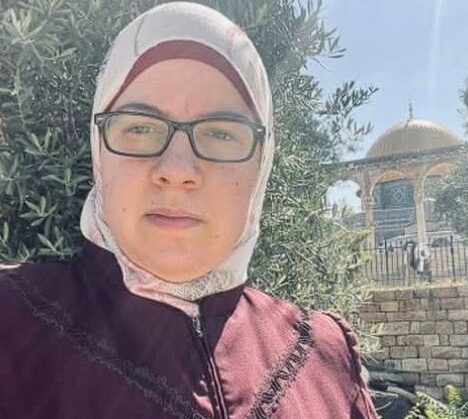
Israeli occupation authorities continued their crackdown on Palestinian expression in occupied Jerusalem and across the occupied West Bank on Sunday, as an Israeli court sentenced Jerusalemite journalist Bayan Al‑Jo‘ba to 20 months in prison over social media posts that prosecutors labeled as “incitement” and “support for a terrorist organization.”
The court also imposed a six‑month suspended sentence, valid for three years, and a 5,000‑shekel fine. It ordered that Al‑Jo‘ba begin serving her sentence on September 6, following more than a year of restrictive house arrest.
Al‑Jo‘ba was first abducted by Israeli forces on February 28, 2025, from inside the Al‑Aqsa Mosque in occupied Jerusalem while she was with her husband, journalist Mohammad Al‑Sadiq, and their two daughters during the sighting of the Ramadan crescent.
She was released hours later due to her medical condition—she was in the final month of a high‑risk pregnancy—but was placed under house arrest and banned from using social media.
On March 20, 2025, Israeli prosecutors filed an indictment accusing her of “incitement,” “support for a terrorist organization,” and “membership in a terrorist organization,” based on posts published on Facebook and Instagram between 2021 and 2024, including personal photos taken inside the Al‑Aqsa Mosque compound.
Over the following year and three months, she was subjected to strict house‑arrest conditions, gave birth to her third child, and was required to attend repeated court hearings. Approximately 13 sessions were held before the final ruling was issued on Sunday. Her lawyer is expected to appeal.
The case reflects a broader pattern in which Israeli authorities prosecute Palestinians—particularly journalists, activists, and residents of occupied Jerusalem—under expansive “incitement” laws.
Human rights organizations have documented that Israel frequently classifies non‑violent online expression as “incitement,” including criticism of Israeli policies, documentation of military invasions, including soldiers and colonizers invasions of Al-Aqsa Mosque, religious phrases, or posts expressing solidarity with Palestinians killed by Israeli forces.
Such charges are often used to justify arrests, house‑arrest orders, bans on social media use, prolonged legal proceedings and imprisonment.
Al‑Ja‘ba’s family and legal team say the ruling is part of a systematic effort to silence Palestinian journalists in occupied Jerusalem and criminalize digital expression under broad and politically applied legal definitions.
