
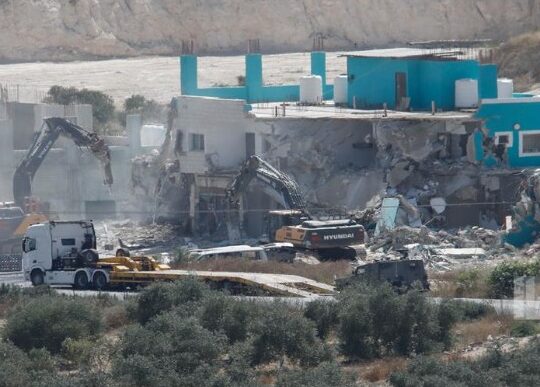
Israeli occupation soldiers demolished at least thirteen Palestinian homes and three structures across the occupied West Bank on Tuesday, extending a wave of destruction that began Monday in Jerusalem, Ramallah, and Jenin.
The demolitions, carried out with heavy machinery and military escorts, left dozens of families displaced and marked a sharp escalation in Israel’s ongoing campaign targeting Palestinian communities under the pretext of “construction without permits.”
In the central West Bank, Israeli forces invaded the village of Shuqba, west of Ramallah, at dawn, accompanied by two military bulldozers, and demolished the home of Mahmoud Bilal Hassan.
مقاطع توثق هدم قوات الاحتلال الإسرائيلي منزلا في قرية شقبا غربي رام الله بالضفة الغربية pic.twitter.com/YrRflV2rBM
— الجزيرة مباشر (@ajmubasher) July 28, 2026
In Bethlehem, Israeli forces demolished an agricultural room belonging to Mousa Abu Rmeis, tore down several walls and fences, and seized a mobile home (caravan) in the village of al‑Malha east of Bethlehem.
Troops also delivered a stop‑work order for a recreational center in Nahalin, west of Bethlehem, consisting of a swimming pool, a room, a kitchen, and a bathroom owned by Ahmad Daoud Shakarna.
The same area was invaded Monday when several homes and structures were marked for demolition.
In the southern West Bank, Israeli bulldozers demolished two homes in Deir Razeh, south‑west of Doura in the Hebron district.
Local resident Ashraf Amro said the homes belonged to Riyad Yasser Amro and Ayman Yasser Amro, each measuring about 120 square meters. The demolition was carried out without allowing residents to remove their belongings.
Villages and communities west of Doura have faced a surge in demolition orders and land seizures as part of expanding colonial plans aimed at tightening Israeli control and imposing new realities on the ground.
In the northern Jordan Valley, Israeli forces demolished residential structures and livestock barns belonging to Adel Elian Daraghma in the Ein al‑Hilwa community.
Israeli occupation bulldozers destroy Palestinian-owned structures in the Bedouin community of Ein Al-Hilweh in the northern Jordan Valley region, northeast of the occupied West Bank. pic.twitter.com/DwqckUiFwP
— Quds News Network (@QudsNen) July 28, 2026
Meanwhile, in Hizma, north‑east of occupied Jerusalem, Israeli authorities bulldozed Palestinian lands and closed several side roads, including one leading to a Bedouin community.
Palestinian National Council President Rawhi Fattouh condemned the wave of demolitions, describing it as part of a comprehensive colonial project designed to enforce creeping annexation, forced displacement, and the emptying of Palestinian land of its indigenous population.
Fattouh stressed that Israel’s justification of “construction without permits” is legally void, as the occupying power has no legitimacy to deny residents under occupation their right to housing and development while continuing to expand illegal colonies and confiscate land.
He said these actions constitute grave violations of the Fourth Geneva Convention, the Hague Regulations, and United Nations Security Council resolutions, as well as the advisory opinion of the International Court of Justice affirming the illegality of occupation and settlement expansion.
Fattouh added that the demolitions and displacement campaigns represent a state policy of collective punishment, forced uprooting, and ethnic cleansing aimed at breaking Palestinian resilience and emptying areas classified as “C” for colonial expansion and de facto annexation.
The official described Israel’s practices as an entrenched system of apartheid enforced through discriminatory laws and measures targeting Palestinians based on national identity, including land confiscation, home destruction, forced displacement, and restrictions on movement and development.
He concluded that these policies amount to crimes under international law that demand accountability and sanctions and urged the international community to assume its legal and moral responsibilities by taking immediate action to halt Israel’s demolition and displacement policy, prosecute those responsible, and impose deterrent measures to ensure respect for international law.
Fattouh warned that continued impunity enables Israel to advance its colonial project and undermine any prospects for a just peace based on ending the occupation and establishing an independent Palestinian state with Jerusalem as its capital.
