
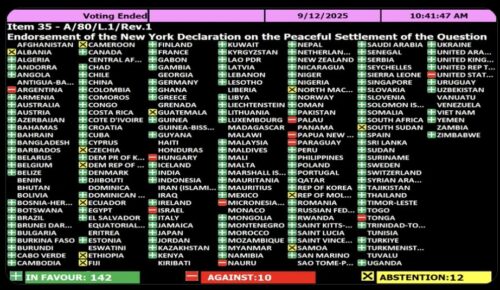
Israel may face significant diplomatic fallout in the coming phase, especially if it chooses to retaliate against the growing wave of international recognition of the State of Palestine. While the immediate consequences remain largely political, analysts warn that the long-term implications could be far more severe.
According to Israel’s Channel 12, legal and academic experts are closely monitoring the situation. Professor Yuval Shany of the Hebrew University noted that most countries had already recognized Palestine prior to the current wave.
“What’s new,” he explained, “is that a group of Western nations is now joining in. That leaves only a handful of influential states that still withhold recognition.”
Among those holdouts is the United States, now the only permanent member of the UN Security Council that does not recognize Palestine. Until recently, the UK and France were also in that category—but both have now shifted their position.
|Recognition of Palestine: Legal, Economic and Diplomatic Impacts|
Former Deputy Attorney General for International Law Roy Schöndorf, now head of Israel’s International Arbitration Division, emphasized the legal permanence of recognition:
“Once a state recognizes another, it cannot revoke that recognition under international law. This marks a turning point for major European powers.”
Schöndorf added that the expanding recognition complicates future political arrangements that exclude Palestinian statehood.
“The change won’t be immediate on the ground,” he said, “but it signals a clear international shift toward accepting Palestine as a sovereign state—even without Israel’s consent.”
|Western Nations Urge Israel to Reopen Gaza Medical Corridor|
In the short term, countries that recognize Palestine are expected to open embassies in Palestinian territories, while Palestine will establish diplomatic missions in those states. Over time, Schöndorf predicts growing pressure on the U.S. government to follow suit.
Potential for Sanctions
Professor Shany warned of possible repercussions if Israel responds by annexing parts of the occupied West Bank.
“The UN General Assembly cannot enforce binding resolutions,” he said, “but its influence could extend to the European Union, which may impose sanctions.”
While no formal sanctions are currently under discussion, Shany noted that any annexation move could trigger economic penalties from the EU. These could affect Israeli exports and lead to restrictions in areas such as culture, education, sports, and research.
With the genocide in Gaza still ongoing and global outrage intensifying, pressure is mounting on European governments to take concrete action against Israel’s policies.
