
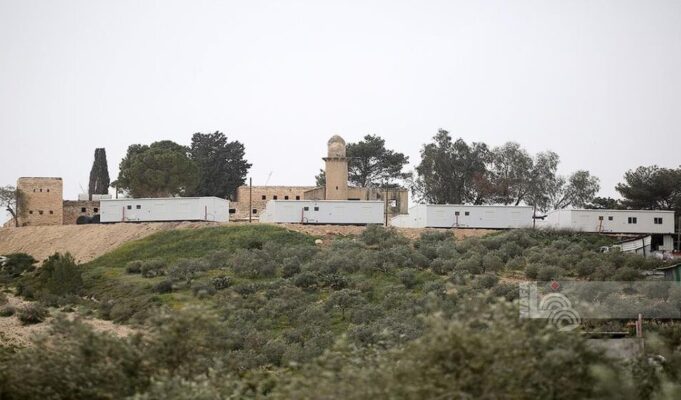
Israeli occupation authorities are advancing a new series of colonial expansion plans in the occupied West Bank, including the first formal construction blueprint to rebuild the evacuated colony of Sanur, north of Jenin, nearly two decades after it was dismantled under Israel’s 2005 “Disengagement Plan.”
The so‑called Higher Planning Council of the Israeli Civil Administration convened to review multiple structural plans for expanding existing colonies and reactivating previously evacuated ones.
Israeli media reported that the agenda includes a proposal to authorize 126 new colonial housing units in Sanur, marking the first time Israel has moved to formally reinstate a colony that was evacuated under the disengagement framework.
|Israeli Colonizers Seize Palestinian Home in Deir Jarir|
According to those reports, the plan envisions private homes and public buildings near the historic hilltop fortress overlooking the area.
If approved, it would constitute a significant policy shift, signaling Israel’s intention to re‑establish a permanent colonial presence in a location it officially evacuated in 2005.
The renewed push follows a public ceremony held on Sunday in which Israeli officials and colonizer leaders declared the “revival” of Sanur.
The event was attended by senior members of the current fundamentalist Israeli government, including Defense Minister Yoav Gallant, Finance Minister Bezalel Smotrich, and Yossi Dagan, head of the Settlements Council in the northern West Bank, along with several leaders of colonizer groups. Officials at the ceremony pledged to rebuild the colony and expand Israeli control over the surrounding area.
Sanur was one of four northern West Bank colonies—along with Homesh, Ganim, and Kadim—evacuated in 2005 when Israel removed its settlements and military installations from Gaza and parts of the West Bank under the unilateral disengagement plan implemented by then–Prime Minister Ariel Sharon.
While the Gaza withdrawal drew international attention, the evacuation of the four West Bank colonies was part of the same legal and military framework.
In March 2023, the Israeli Knesset voted to repeal key sections of the Disengagement Law, enabling Israelis to return to the evacuated areas.
The repeal was widely criticized by Palestinian officials and international observers, who warned that it would accelerate settlement expansion and further entrench Israel’s de facto annexation of the West Bank.
Since the repeal, Israeli authorities and colonizer groups have intensified efforts to re‑establish Homesh—where an illegal outpost and religious school have already been installed—and have repeatedly demanded the reconstruction of Sanur. The new planning session represents the most advanced step yet toward formalizing that objective.
The Wall & Colonization Resistance Commission and other Palestinian institutions have warned that reviving Sanur and other evacuated colonies is part of a broader Israeli strategy to expand settlement blocs, seize additional Palestinian land, and impose irreversible facts on the ground.
They note that the northern West Bank has experienced a sharp rise in colonizer violence, land confiscation, and new outposts since 2023, particularly under the current far‑right Israeli government.
The advancement of the Sanur plan comes amid a wider surge in Israeli settlement activity across the occupied West Bank, where more than 700,000 Israeli colonizers now live in colonies considered illegal under international law.
The Higher Planning Council’s agenda includes additional expansion plans in several other colonies, reflecting what Palestinian rights groups describe as an accelerated annexation drive carried out under military protection.
All of Israel’s colonies in the occupied West Bank, including those in and around occupied East Jerusalem, are illegal under International Law, the Fourth Geneva Convention, in addition to various United Nations and Security Council resolutions. They also constitute war crimes under International Law.
Article 33 of the Fourth Geneva Convention prohibits collective punishment and acts of terror against civilian populations.
Article 49 of the Fourth Geneva Convention states: “The Occupying Power shall not deport or transfer parts of its own civilian population into the territory it occupies.” It also prohibits the “individual or mass forcible transfers, as well as deportations of protected persons from occupied territory”.
Articles 53 and 147, prohibit the destruction of civilian property and classify pillage as a war crime.
