
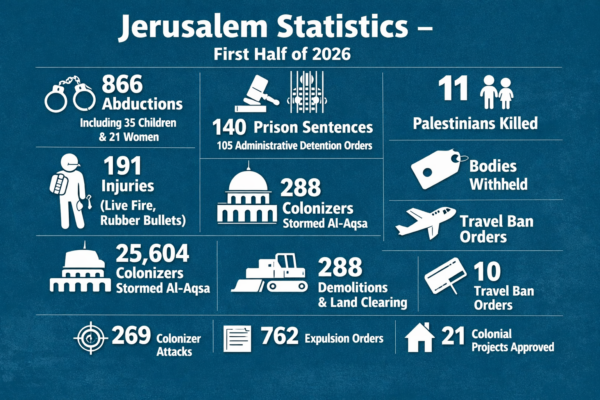
The Jerusalem Governorate reported that eleven Palestinians were killed in the first half of 2026 across occupied Jerusalem, amid continued field executions by Israeli forces and escalating attacks by armed colonizers.
Three Palestinians were killed by Israeli paramilitary colonizers, while eight others were shot dead by Israeli forces, including two laborers targeted near the Annexation Wall in al‑Ram as they attempted to reach their workplaces.
The report documented an unprecedented escalation at Al‑Aqsa Mosque, where 25,604 colonizers stormed the courtyards and 24,912 others entered under the guise of “tourism,” all under heavy police protection.
Israeli occupation authorities imposed an almost complete closure on the mosque from February 28 through April 9, the longest such shutdown since 1967, restricting access to a small number of imams and Waqf guards while barring worshippers entirely.
Violations included public Talmudic rituals, distribution of Torah scrolls, attempts to bring “Passover sacrifices” into the mosque, raising Israeli flags inside the courtyards, and extending colonizer incursions to six and a half hours daily.
The report noted intensified official calls to build a synagogue inside Al‑Aqsa as part of efforts to impose new spatial and temporal divisions.
A total of 191 injuries were recorded, including 37 laborers, resulting from live fire, rubber‑coated bullets, severe beatings, tear‑gas inhalation, pepper‑spray assaults, vehicular attacks, and stone‑throwing. Victims included children, women, workers, and Christian clergy.
The governorate documented 269 colonizer attacks, including 52 physical assaults, targeting Al‑Aqsa, Bedouin communities, homes, Islamic and Christian sites, and private property.
These attacks resulted in the killing of three Jerusalemites and included shootings, arson, home takeovers, road closures, and attempts to bring sacrificial offerings into Al‑Aqsa.
Israeli forces carried out 866 abductions of Palestinians, including 35 children and 21 women, through home invasions, abductions at military roadblocks, and intimidation tactics. Those targeted included activists, journalists, former prisoners, and laborers from other districts.
Israeli courts continued issuing punitive measures, including movement restrictions, heavy fines, forced house arrest, expulsion orders, and travel bans. The report documented 140 sentences against Jerusalemite prisoners, including 105 administrative detention orders—without charges or trial—and 18 actual prison terms. House arrest remained a key tool of coercion, with 31 orders issued.
Occupation Authorities also issued 762 expulsion orders targeting Al‑Aqsa and the Old City, and ten travel‑ban orders against religious and national figures.
The report also documented 288 demolitions and land‑clearing violations—the highest in six years—including 66 forced self‑demolitions and 198 demolitions carried out by Israeli machinery.
A total of 352 demolition, eviction, confiscation, and stop‑construction orders were issued, primarily targeting densely populated Palestinian neighborhoods such as Silwan, Baten al‑Hawa, and ‘Anata, in efforts to reshape Jerusalem’s demographic landscape.
The report highlighted intensified targeting of religious and national leaders, including legal persecution of Jerusalem Governor Adnan Ghaith, travel bans against Sheikh ‘Ekrema Sabri, and expulsion orders against several imams and religious figures.
Institutions also faced broad attacks, including closures of Al‑Aqsa, restrictions on worship, targeting UNRWA facilities, storming cultural centers, and raiding schools. Journalists and media institutions faced abductions, assaults, and coverage bans.
The governorate documented 89 colonial plans and projects, including deposited and approved settlement plans totaling thousands of new units.
June 2026 alone saw fourteen new colonial plans, reflecting accelerated settlement expansion aimed at consolidating Israeli control over occupied Jerusalem and erasing Palestinian presence across the city.
