
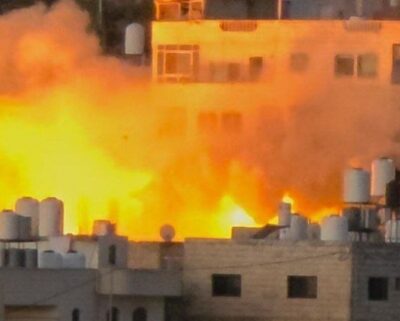
Israeli occupation forces detonated the home of 23‑year‑old Mahmoud Yousef Aabed at dawn on Monday in the town of Halhul, north of Hebron in the southern part of the occupied West Bank.
Large military units, accompanied by armored vehicles, trucks, and heavy equipment, invaded several neighborhoods in Halhul before surrounding the Aabed family home.
An Israeli explosive‑engineering team was deployed to the area, and troops imposed a tight cordon around the building.
Israeli military engineers later planted explosive charges inside the walls of Aabed’s apartment, located within a multi‑story residential building, and then detonated it.
Residents of nearby homes were forced to evacuate before the detonation. Local sources said that among those evacuated were individuals with medical conditions who received treatment from Palestinian Red Crescent Society emergency teams.
 Mahmoud Aabed was killed on July 10, 2025, after reportedly carrying out a stabbing and shooting attack at the Gush Etzion junction north of Hebron, along with 23‑year‑old Malek Ibrahim Abdul‑Jabbar Salem. An Israeli security guard was killed in the incident before Israeli forces opened fire on the two Palestinians, resulting in their deaths.
Israel’s policy of detonating or demolishing family homes as retaliation for alleged or confirmed attacks has long been condemned by human rights organizations and legal experts as a form of collective punishment.
The practice targets relatives who are not accused of wrongdoing, displacing families and destroying civilian property in violation of international humanitarian law, including the Fourth Geneva Convention, which explicitly prohibits collective penalties and reprisals against protected persons.
Rights groups note that such actions inflict long‑term social and economic harm on entire households and surrounding communities and serve no legitimate military purpose under international legal standards.
