
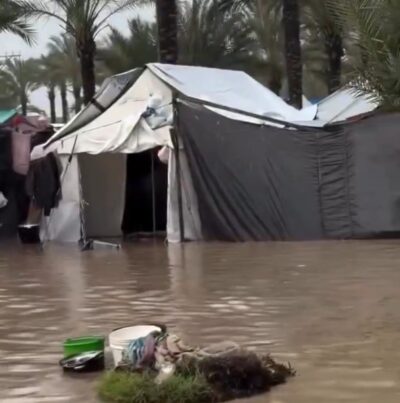
Buildings Collapse, Camps Flood, UNRWA Warns of Preventable Suffering: A powerful winter storm struck the Gaza Strip, causing the collapse of several residential buildings and flooding vast displacement camps, compounding the already dire humanitarian crisis.
Palestinian Civil Defense teams reported the collapse of three multi‑story structures in Gaza City, including a three‑story home in al‑Nasr and another in al‑Zeitoun, in Gaza city.
No casualties were confirmed, but officials urged residents to evacuate buildings at risk of collapse as the storm intensified.
In #Gaza, winter rains are falling, once again, bringing new hardships.
Flooded streets and soaked tents are making already dire living conditions even more dangerous.
Cold, overcrowded, and unsanitary environments heighten the risk of illness and infection.
This suffering… pic.twitter.com/U3Sub8oqgX
— UNRWA (@UNRWA) December 11, 2025
Rescue crews said the storm submerged entire camps in al‑Mawasi near Khan Younis, in southern Gaza, with additional flooding in Deir al‑Balah’s al‑Bassa and al‑Baraka neighborhoods, Nuseirat’s central market, in central Gaza, and Gaza City’s Yarmouk and port districts.
Over a 12‑hour period, emergency teams responded to 32 incidents, including evacuations of families, rescues from 17 inundated tents, and water‑draining operations.
Gaza’s Government Media Office reported that more than 22,000 tents have been destroyed by successive storms, leaving 1.5 million displaced Palestinians in deteriorated shelters.
Director Ismael Thawabta warned that displaced families lack even the minimum means of survival, living without protection from cold, wind, or rain. He added that only 20,000 tents have entered Gaza since the crisis began, while at least 300,000 are urgently needed.
In #Gaza, “the sewer system has collapsed completely. There are lakes of untreated sewage, and people are living amongst this,” our @UN_JWFowler tells @TRTWorld.
UNRWA teams continue to clear waste, pump sewage, and provide healthcare to displaced families under extreme… pic.twitter.com/m9cPYp7ih7
— UNRWA (@UNRWA) December 11, 2025
UNRWA issued a stark statement: “In Gaza, winter rains are falling, once again, bringing new hardships. Flooded streets and soaked tents are making already dire living conditions even more dangerous. Cold, overcrowded, and unsanitary environments heighten the risk of illness and infection. This suffering could be prevented by unhindered humanitarian aid, including medical support and proper shelter. That would help families face winter in safety and dignity.”
Al Jazeera Arabic reported that in Khan Younis, an eight‑month‑old baby girl died of exposure in a flooded tent.
Her mother recounted that she found her child lifeless after hours of relentless rain and cold.
Al Jazeera English highlighted that families are sleeping on soaked mattresses, with no dry clothes or blankets, while sewage and rainwater mix in the camps, spreading contamination.
The storm has also devastated emergency infrastructure. Temporary water networks collapsed, mixing with floodwater and increasing pollution.
Ten mobile medical units ceased operating due to equipment loss, and health teams were unable to reach large sections of the camps.
Palestinian Civil Defense spokesperson Mahmoud Basal warned that the storm sweeping Gaza has led to a “complete collapse” of emergency shelter centers, with tents across the Strip inundated and rendered uninhabitable.
He said rescue crews are operating under extremely hazardous conditions as families lose the only protection they had, stressing that Gaza is facing a catastrophic reality that requires urgent international intervention to end the ongoing blockade.
Basal appealed for the immediate entry of caravans, construction materials, and equipment to replace the destroyed tents and establish safe shelters, cautioning that without swift action more lives will be lost.
Storm Byron is hitting the Gaza Strip. Hundreds of thousands of people displaced by Israeli genocidal attack are huddling in makeshift tents, many flooded due to the mass bombing of sewage and drainage systems. Two years of genocide have left this vulnerable population exposed… pic.twitter.com/DcHwclzUf0
— B’Tselem בצלם بتسيلم (@btselem) December 11, 2025
Aid groups say Israel has failed to meet its ceasefire obligation of allowing 600 trucks of aid per day, with only a fraction of the needed supplies reaching Gaza.
Shelter Cluster data shows that just 15,590 tents have entered Gaza through UN and NGO channels, alongside 48,000 from foreign governments — far below the required threshold.
International observers warn that the contrast with conditions in Israel, where flood warnings were issued but no major emergencies reported, underscores the devastation wrought by war and blockade on Gaza’s infrastructure.
UN Special Rapporteur Francesca Albanese described the situation as an “unstoppable nightmare,” with thousands left to freeze and starve.
As the storm continues into Friday, with temperatures dropping and rainfall intensifying, humanitarian agencies stress that without immediate shelter and medical support, Gaza faces a preventable disaster.
