
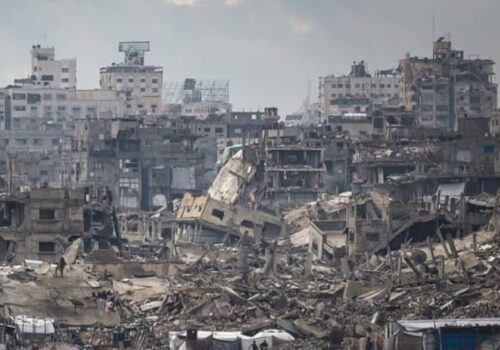
Israeli occupation forces killed several Palestinians and wounded others on Sunday in multiple areas across the devastated Gaza Strip, as continued shootings, shelling, and “ceasefire” violations compounded the already severe humanitarian crisis and heightened fears of renewed large‑scale military escalation.
Medical sources confirmed that Hala Salem Darwish, 25, was shot and killed inside her home east of the al‑Maghazi refugee camp in central Gaza.
She was struck by an Israeli sniper near the UNRWA clinic in the camp. Relatives said she had been preparing for her wedding, scheduled for May 1, 2026.
In a separate attack, Israeli shelling targeted a motorcycle in the Nuseirat refugee camp in central Gaza, killing Ayman Abu Hasna and injuring three others. His body and the wounded were transferred to al‑Awda Hospital in Nuseirat.
An Israeli aircraft targeted a motorcycle in the Nuseirat refugee camp in central Gaza, killing one person and injuring others. pic.twitter.com/z9Lri5yDtd
— TIMES OF GAZA (@Timesofgaza) April 19, 2026
Another Palestinian, Anas Khaled Safi, was killed in an Israeli bombing of the Al-Bureij refugee camp, in central Gaza.
Earlier in the day, Khalil Nasr, 24, was killed after being shot in the head by Israeli forces in the Halawa displacement camp in Jabalia in the northern Gaza Strip.
Hours later, two Palestinians were wounded by Israeli gunfire in the same area. Another displaced man was also shot west of Deir al‑Balah in central Gaza.
Meanwhile, Israeli Channel 14 reported that the Israeli military is preparing for a return to intense combat operations in Gaza at the beginning of next month. The report said the decision followed what it described as “Hamas’ refusal to disarm or dismantle its military capabilities.”
Israeli Finance Minister Bezalel Smotrich renewed his call for the full re‑occupation of the Gaza Strip and the establishment of Israeli colonies there.
According to Channel 14, Smotrich made the remarks during a visit to the re‑established Sanur illegal colony on stolen Palestinian land in the northern occupied West Bank, which was evacuated in 2005 under the “disengagement plan.”
Despite a “ceasefire” agreement that remains nominally in effect, Israel continues to carry out daily violations, including shootings, shelling, and restrictions on movement and aid.
According to the Palestinian Ministry of Health in Gaza, the Israeli army has committed 2,400 ceasefire violations since the agreement took effect on October 10, 2025, resulting in 775 Palestinians killed and 2,171 wounded.
The “ceasefire agreement”—implemented as part of the first phase of a UN‑backed plan adopted under Security Council Resolution 2803—was supposed to include a halt to military operations and the entry of agreed‑upon quantities of food, medical supplies, and shelter materials. Palestinian officials say Israel continues to evade these commitments.
Child Kareem Al-Mutawaq died after suffering a cardiac arrest caused by intense explosions near civilian homes in Gaza City. pic.twitter.com/03EONY1Mnf
— TIMES OF GAZA (@Timesofgaza) April 19, 2026
According to official Palestinian data, Israel has now killed more than 72,551 Palestinians, wounded over 172,574, and destroyed about 90% of Gaza’s infrastructure, leaving the population facing extreme shortages of food, water, medical care, and shelter.
Humanitarian agencies and UN bodies note that casualty figures from Gaza are compiled primarily by the Ministry of Health, which relies on reports from hospitals and clinics, as well as bodies and wounded brought in by first responders and families.
The child Anas Abu Amra (1.5 years old) is battling leukemia and an enlarged liver under dire conditions in the Gaza Strip.
His severely swollen abdomen cries out in pain, and local hospitals are unable to provide the life-saving treatment he needs. pic.twitter.com/LqhrMVZJSu— Eye on Palestine (@EyeonPalestine) April 19, 2026
As health facilities, civil registries, and communications networks have been repeatedly bombarded and disrupted, large areas have become inaccessible, making it difficult to document all deaths and injuries in real time.
For this reason, international organizations treating these figures as the main reference point also acknowledge that they are likely an undercount, as many victims remain trapped under rubble or in areas that rescue teams cannot safely reach.
Despite these limitations, UN agencies and independent researchers have repeatedly assessed the Ministry’s aggregate tolls as broadly consistent and methodologically sound for use in humanitarian reporting and planning.
