
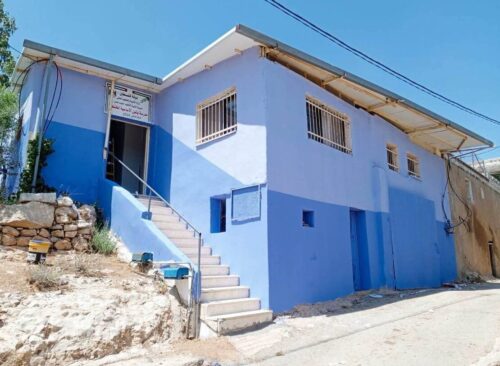
Illegal Israeli paramilitary colonizers demolished the Yanun Mixed Basic School, south of Nablus, on Thursday, destroying a facility that had served 15 Palestinian children from grades one through six, and had been internationally classified and documented as the smallest school in the world, according to the Palestinian Ministry of Education.
The school was torn down nearly eight months after the forced displacement of the residents of Khirbet Yanun, where the school had operated for years as the only educational access point for children in the isolated community.
In its statement, the Ministry of Education said the demolition constitutes a new crime against Palestinian children, and a blatant violation of international humanitarian law and global conventions that guarantee the right to education and prohibit attacks on educational institutions.
The Ministry added that the school had provided essential access to learning for 15 students, forming a critical pillar for ensuring that children in the community could reach basic education despite ongoing pressures and threats.
It stressed that the demolition is part of a systematic policy aimed at undermining the educational process, imposing further hardship on Palestinian communities, and depriving children of their fundamental right to education.
The Ministry affirmed that, in cooperation with partner institutions, it will continue taking all necessary steps to ensure the students’ education continues despite ongoing violations.
It called on the international community, the United Nations, and human rights and humanitarian organizations to uphold their legal and moral responsibilities, take urgent practical measures to protect education in Palestine, and hold Israel accountable for repeated attacks on students and schools.
Over the past two years, colonizer attacks across the occupied West Bank have sharply escalated, a trend verified and documented by multiple international and Israeli human rights organizations.
The United Nations Office for the Coordination of Humanitarian Affairs (OCHA) reports a record increase in colonizer violence since 2023, noting that attacks have become more frequent, more organized, and more destructive, particularly in rural Palestinian communities.
Human Rights Watch (HRW) and the Israeli rights groups B’Tselem and Yesh Din have all documented that colonizer assaults are often carried out by armed groups linked to illegal outposts, and that these attacks frequently occur in the presence of Israeli soldiers.
These organizations have repeatedly stated that colonizers operate with systematic impunity, with Israeli authorities failing to prevent attacks or prosecute perpetrators. This pattern is not speculative — it is based on published investigations, field documentation, and verified incident reports.
OCHA’s data shows that rural areas near expanding outposts — including the Nablus district, the Jordan Valley, the South Hebron Hills, and villages west and east of Ramallah — are among the most affected. These regions are targeted because they lie near lands colonizers seek to seize.
HRW and B’Tselem have documented that repeated assaults, threats, livestock theft, arson, and destruction of infrastructure have led to the forced displacement of multiple Palestinian communities since 2023. This displacement is classified by OCHA and HRW as forcible transfer, which is prohibited under the Fourth Geneva Convention.
Attacks on schools, clinics, agricultural roads, and water systems have also been verified. UNICEF and OCHA have both reported increasing incidents in which colonizers damage or destroy educational facilities, vehicles transporting children, and community infrastructure.
The demolition of the Yanun Mixed Basic School — internationally classified as the smallest school in the world — fits into this documented pattern of targeting essential services to pressure Palestinian families to leave.
Also Thursday, Israeli colonizers carried out multiple attacks across the occupied West Bank, targeting Palestinian homes, agricultural lands, vehicles, and public facilities. The assaults occurred under the protection of Israeli occupation forces and were reported in Salfit, Jenin, Nablus, and Ramallah.
In addition, Israeli occupation forces demolished two Palestinian homes on Thursday in separate areas of the West Bank, continuing a pattern of systematic destruction targeting residential structures and privately owned property. The demolitions took place in the Salfit district in the central West Bank and the Hebron district in the southern West Bank.
The army also uprooted hundreds of trees on Thursday in the village of ‘Atouf and the ar‑Ras al-Ahmar, east of Tubas in the northeastern occupied West Bank, as part of ongoing land clearing operations to construct a military road and erect a separation wall in the area.
Human rights organizations consistently describe colonizer violence as systematic, organized, and directly linked to the expansion of illegal colony outposts. This is not an interpretation — it is the language used in official reports by OCHA, HRW, B’Tselem, and Yesh Din. These organizations also confirm that colonizer attacks frequently occur under military protection or in areas where new military roadblocks have recently been imposed.
The escalation has had severe, measurable consequences. OCHA reports thousands of olive trees burned or uprooted, widespread harassment of shepherds and farmers, and increasing isolation of Palestinian villages. UNICEF confirms that children in affected communities face growing barriers to accessing education, including school closures, road blockages, and direct attacks on school facilities.
